In civil engineering, rock bolts play a critical role as a support structure. With the demands for efficiency and quality in construction rising due to rapid urbanization, traditional rock bolt technology often struggles to meet all engineering needs. In this context, self-drilling anchor bolts have emerged as a preferred solution for challenging geological conditions. In gravel strata, in particular, self-drilling anchor bolts demonstrate significant potential and market value due to their unique advantages. This article will explore the application of self-drilling anchor bolts in gravel strata. It will also discuss how their innovative technology and superior performance bring more efficient and reliable anchoring solutions to modern civil engineering.
Overview of Self-Drilling Anchor Bolts
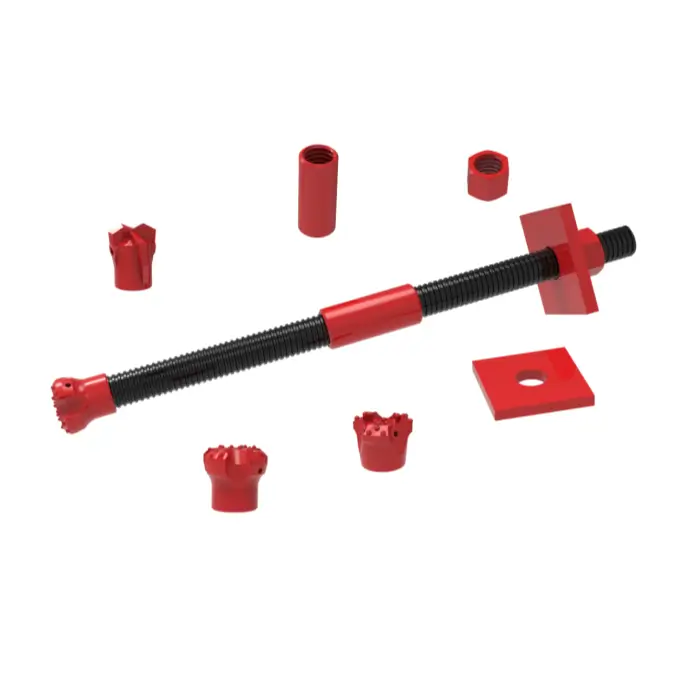
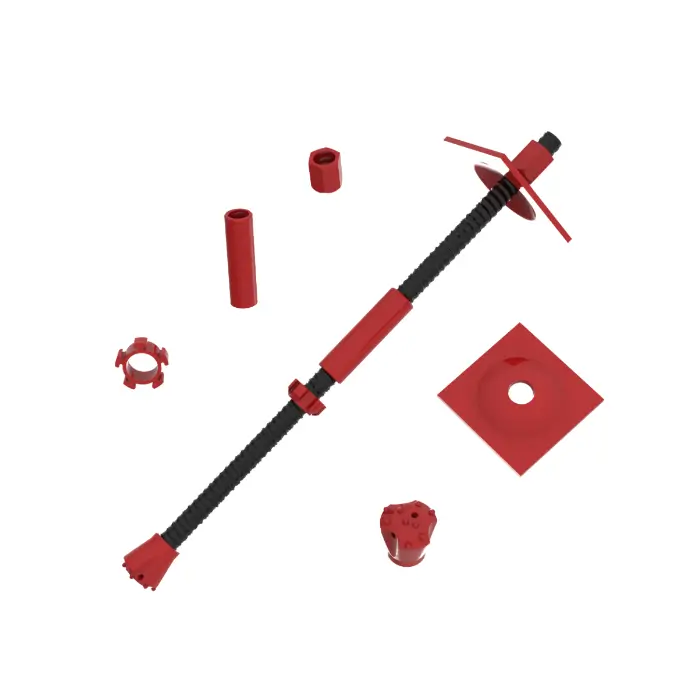
Self-drilling anchor bolts integrate drilling, grouting, and anchoring functions in a streamlined, high-efficiency construction process with excellent anchoring results. They effectively address challenges such as hole collapse and difficulty forming holes during drilling. Self-drilling anchor bolts include six main components: a hollow anchor rod, drill bit, coupler, plate, nut, and centralizer. The hollow anchor rod is usually constructed from thick-walled seamless steel tubing, which is threaded along its length to ensure strength connections and efficient grouting. The drill bit is made from wear-resistant metal and features outlets for grout. A coupler seamlessly connects anchor rods for continuous extension, while a plate at the end of the rod transfers the anchoring force to the rock layer. The nut stabilizes the anchor rod, and the centralizer ensures it stays centered in the borehole.
Compared to traditional rebar rock bolts, self-drilling anchor bolts offer notable advantages. They don’t require casing, combining drilling and grouting to solve issues like hole collapse and slow drilling in gravel strata. Additionally, they are highly efficient, safe, and reliable, with excellent anchoring quality, making them well-suited for weak, fragmented, and loose rock layers.
Characteristics and Challenges of Gravel Strata
Gravel strata are common in geologic formations and characterized by large, unevenly distributed particles such as pebbles. These formations often pose challenges in construction, including hole collapse, slow drilling speed, and high construction difficulty. Traditional rock bolt support methods struggle to achieve desired results in gravel strata. Self-drilling anchor bolts offer a unique construction process and superior anchoring performance, making them an optimal solution.
Advantages of Self-Drilling Anchor Bolts in Gravel Strata
Solving Construction Challenges
Due to the large, loose particles in gravel strata, traditional rock bolt construction requires casing, which is inefficient and costly. Self-drilling anchor bolts eliminate the need for casing, enabling simultaneous drilling and grouting to solve these issues. As drilling progresses, the slurry forms a composite anchor body with sediment and rock, enhancing anchoring effectiveness.
Increased Construction Efficiency
The self-drilling anchor bolts’ combined drilling and grouting process significantly shortens the construction period, eliminating the need for pre-drilling and boosting efficiency.
Superior Anchoring Performance
Self-drilling anchor bolts deliver excellent anchoring in gravel strata. Field pull-out tests show high ultimate pull-out capacity, meeting engineering requirements. Although the average bond strength between the anchor body and soil decreases with increased anchor length, it remains within acceptable limits. The stress from the anchor rod, shear stress, and stress in the anchor body display an exponential distribution along the anchoring depth, further illustrating robust performance.
Versatility
Self-drilling anchor bolts adapt well to various complex geological conditions. Their unique drilling and grouting process optimizes performance in gravel strata, fulfilling engineering demands.
Significant Economic Benefits
Besides improving construction efficiency, self-drilling anchor bolts bring considerable economic benefits. Without the need for casing, material and construction costs decrease. Additionally, their faster construction speed shortens project timelines, reducing labor and equipment rental expenses. The rock bolt’s effective anchoring enhances excavation stability, lowering long-term maintenance costs.
Conclusion
The use of self-drilling anchor bolts in gravel strata shows significant adaptability, efficiency, and economic benefits, along with excellent anchoring effectiveness. Faced with variable conditions in gravel formations, self-drilling anchor bolts address the limitations of traditional rock bolts by providing self-drilling and self-grouting capabilities, high pull-out resistance, and an efficient construction process. As technology advances and practical experience grows, the future of self-drilling anchor bolts in gravel strata looks promising, with potential applications across more fields, contributing to safer and more sustainable civil engineering. Therefore, further research and promotion of self-drilling anchor bolt technology is crucial for advancing global construction standards and quality.